Every board you sit on. Each one remembered.
Quorums reads every pack, minute and transcript from every board you sit on, and holds each board’s record so you can ask it directly.
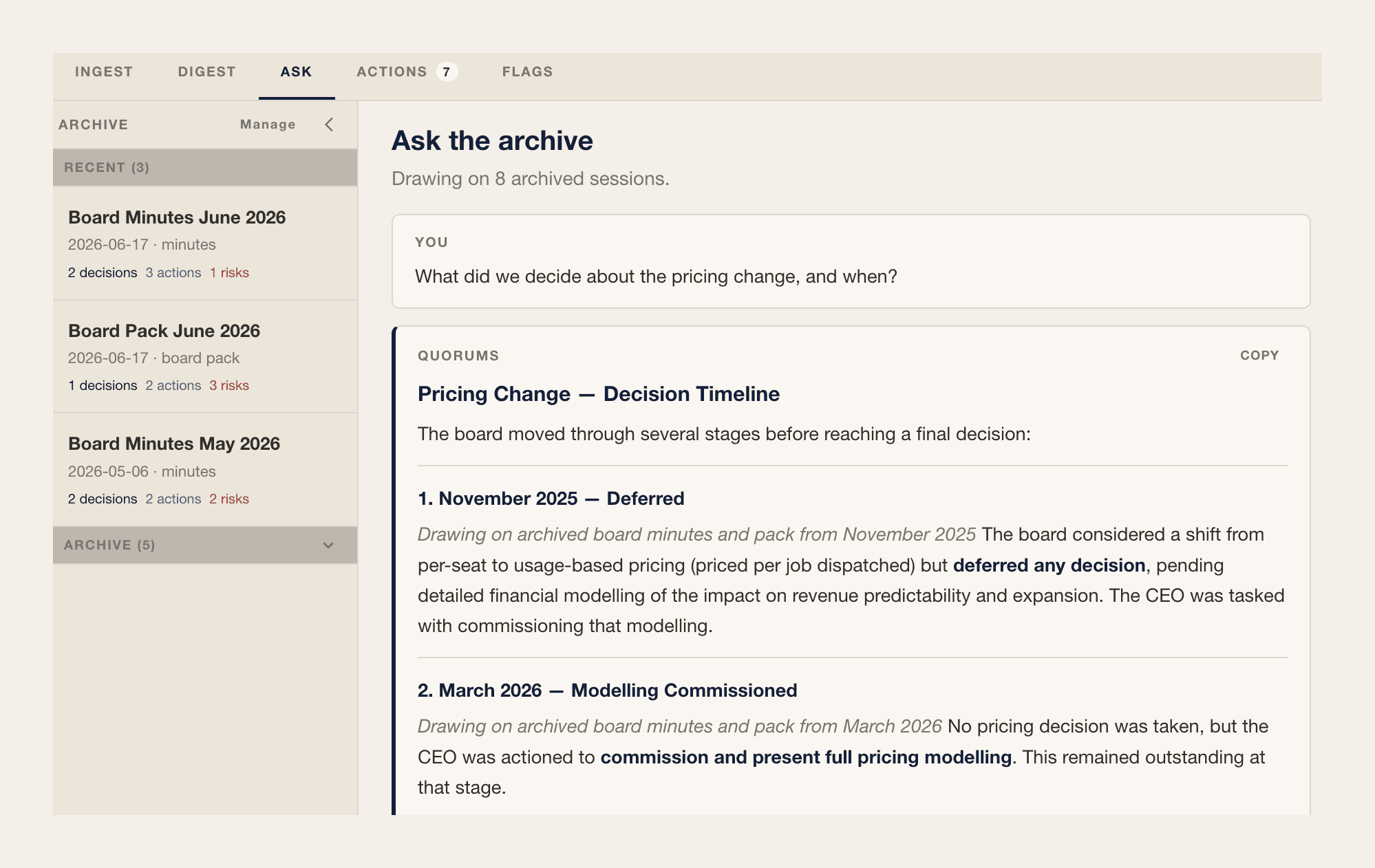
Decisions
What did we decide, and when?
Every resolution, approval and deferral, captured from the packs and minutes: dated, attributed, and answerable in seconds. The question that used to mean an hour in old PDFs now takes one sentence.
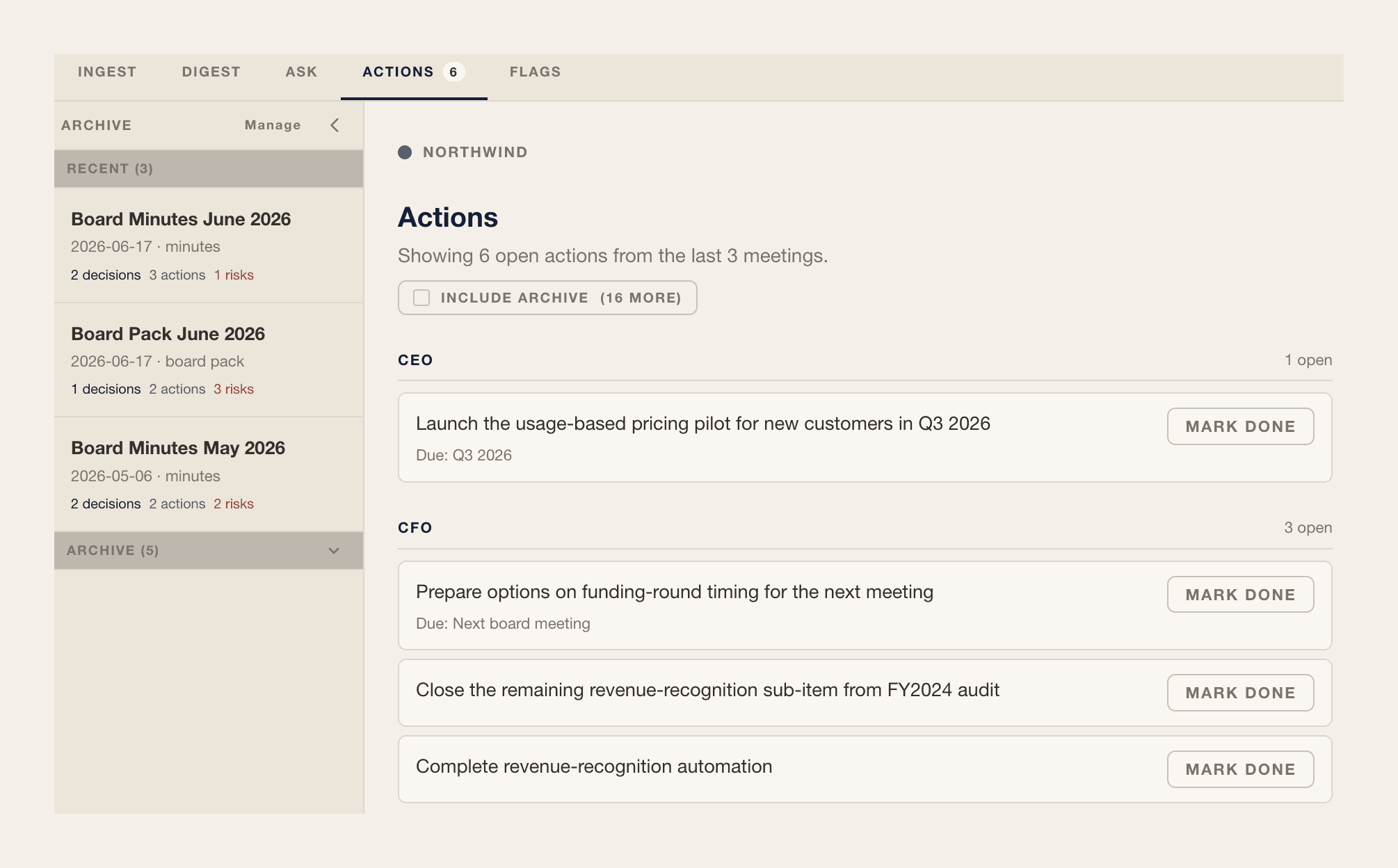
Actions
What did we say we’d do?
Commitments made in one meeting have a habit of going quiet by the next. Quorums carries every action forward from pack to pack, and the ones that slip surface on their own. Nobody has to be the person who asks.
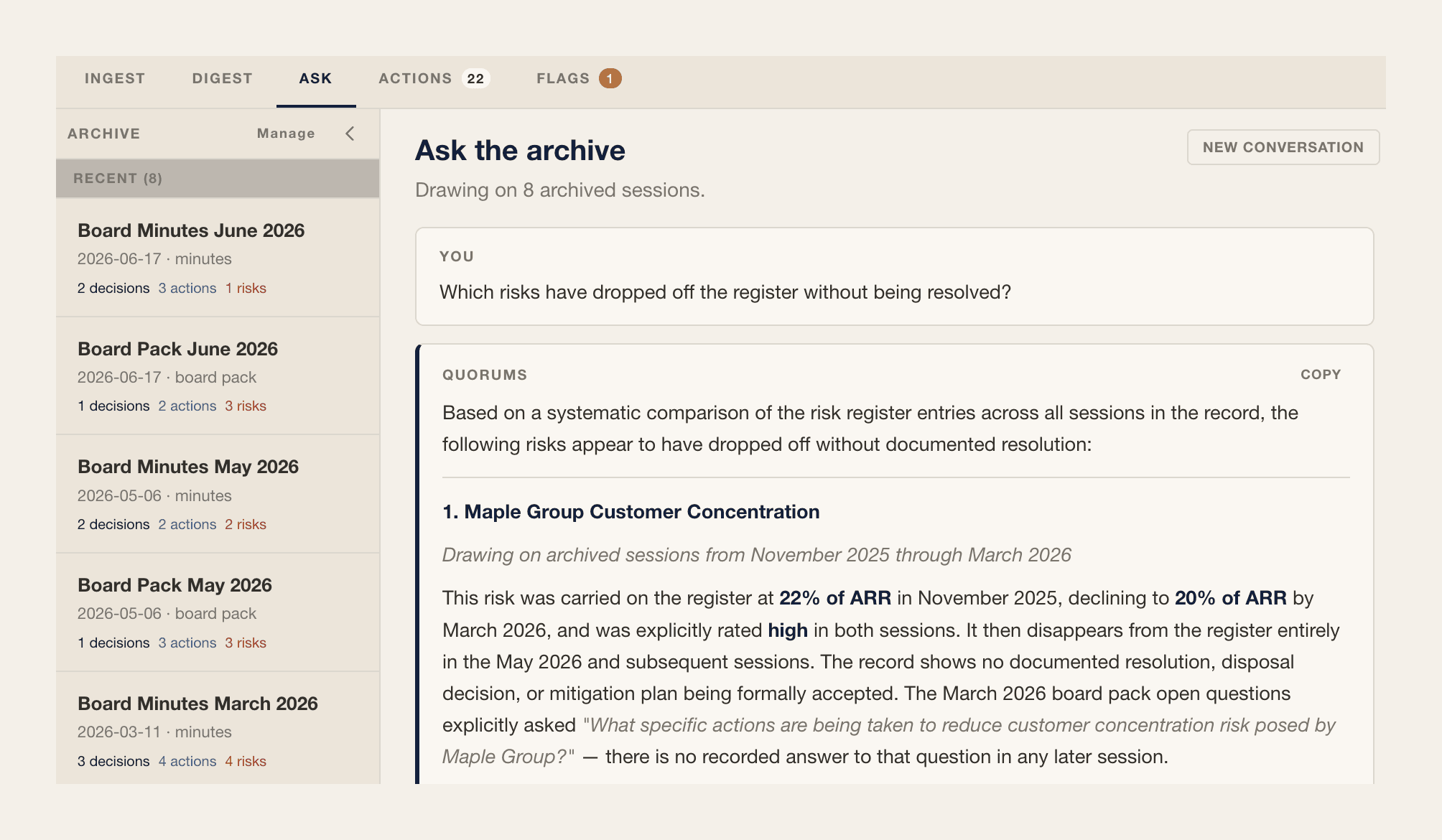
Risks
Which risks disappeared without being resolved?
A risk that vanishes from the register has either been retired or quietly forgotten, and the difference matters. Quorums tracks each one across meetings and tells you which it was.
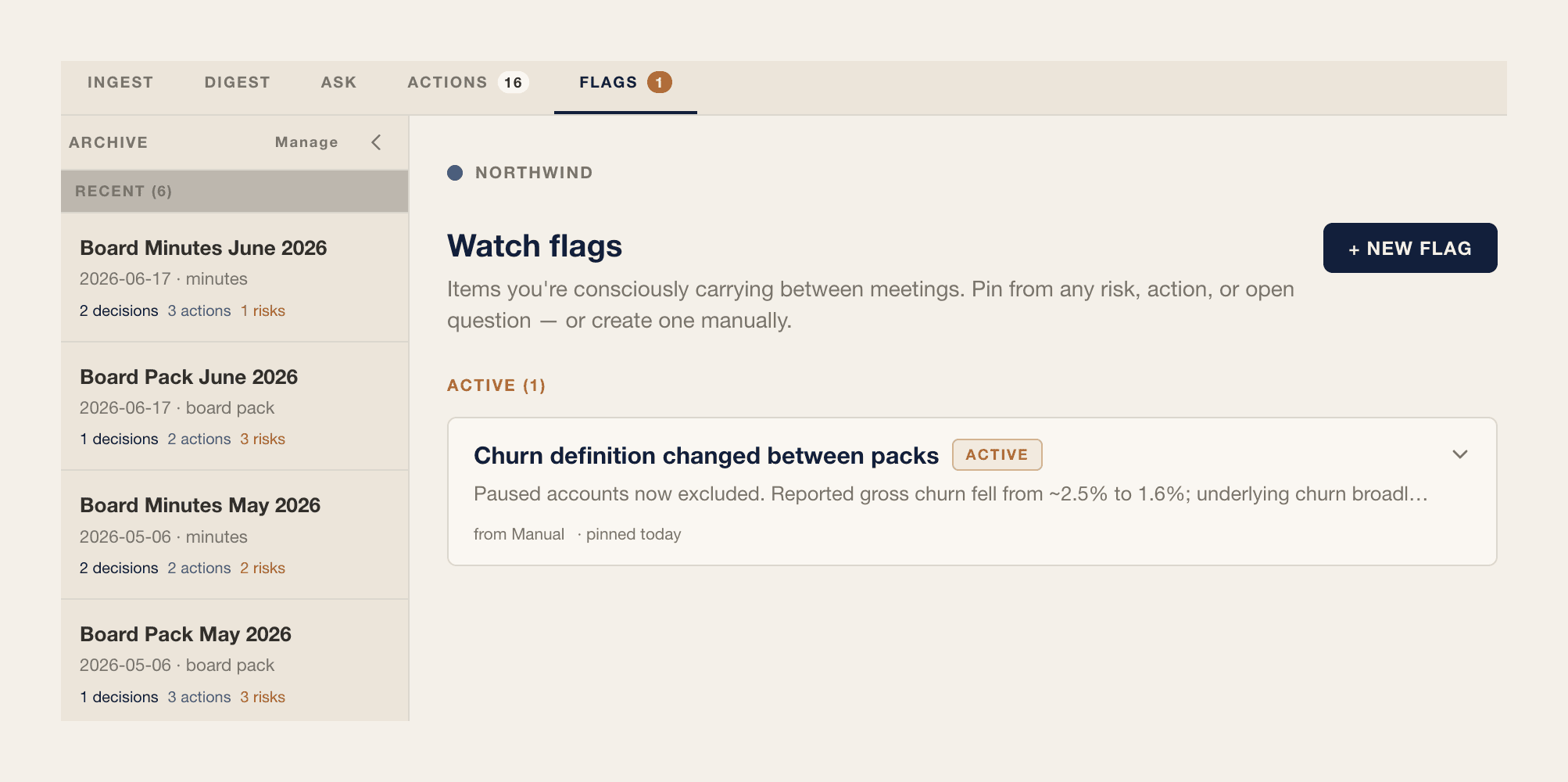
Watch flags
What deserves a second look?
Some things in a pack aren’t decisions, actions or risks yet: they’re the detail a good chair notices and returns to. Quorums marks them in gold and holds them until you do.
Every board
All of them, at a glance.
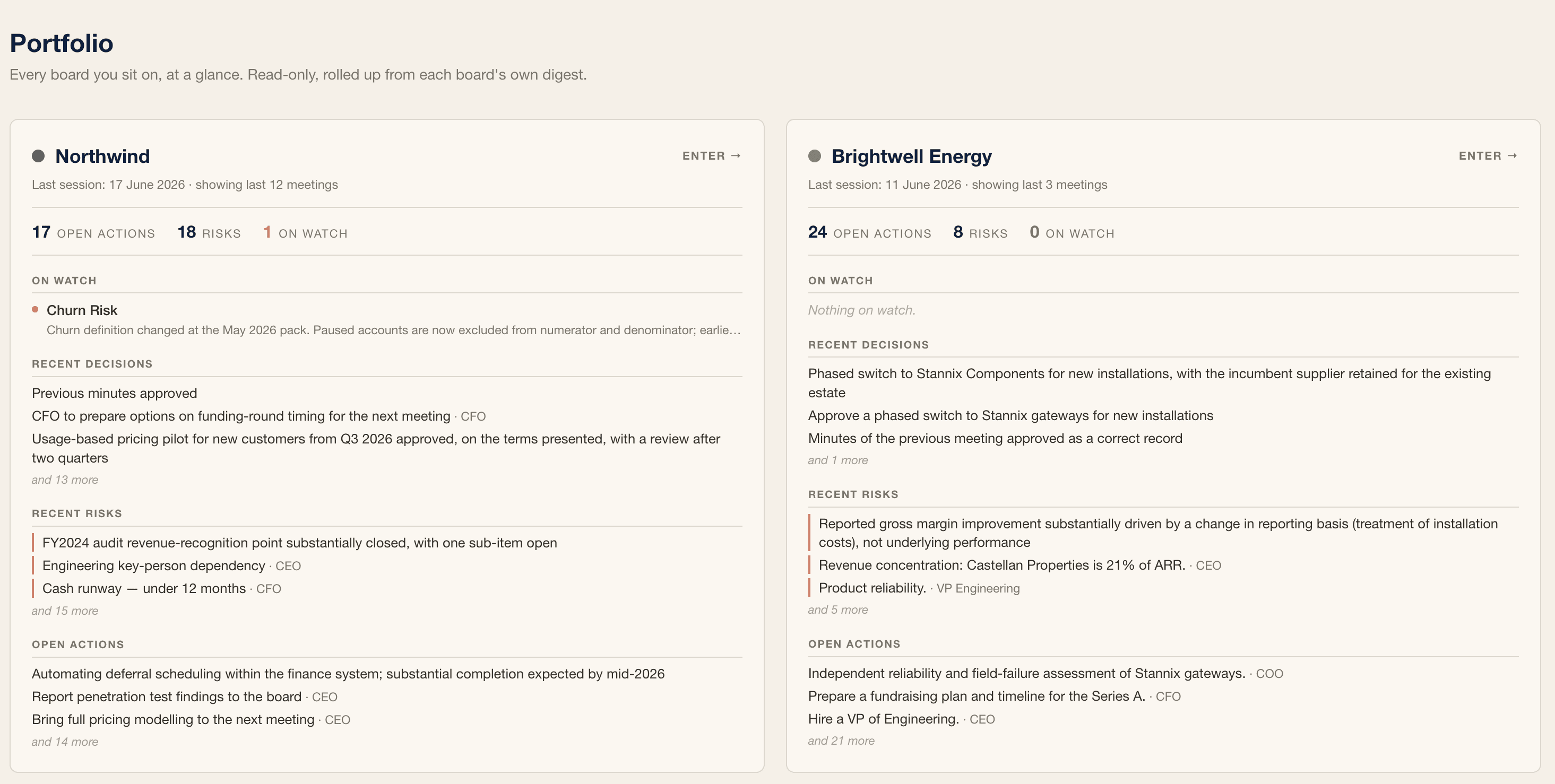
Most chairs and NEDs sit on three or four boards, and each one lives in its own folder, its own thread, its own head. Quorums puts them on one screen: open actions, live risks, and what is on watch, rolled up from each board’s own record. You see where things stand everywhere before you open anything.
One seat. Every board.
The alternative is not a portal. It is a folder.
Right now, your board’s history is probably scattered across email threads, a shared drive, and a folder of attachments. Findable, just about, and rarely as secure as it ought to be. But a pile of files is not a memory. You can open last March’s pack; you can’t ask it what changed since November, which commitments went quiet, or what you asked management to come back on. Quorums reads what’s inside (every pack, every set of minutes, every transcript) and remembers it, board by board, year over year.
And it is not a chatbot either. Why not just use Claude?
Built for confidential board material.
Every request that touches board content is checked against your membership of that board before anything is read, on every path without exception. We maintain an automated suite that attempts cross-board access on each one and asserts it fails, and it runs before any change ships. The AI that reads your documents is stateless: it holds no memory between requests and builds no cross-customer knowledge. Board content is retained by our AI provider for 30 days, then deleted, and is never used to train models.
What Quorums does not do.
Some of these are technical limits. Some are choices. All of them are deliberate.
- It does not take your minutes. Quorums reads what has already been recorded. It is not in the room, it does not listen, and it does not produce the record.
- It does not assess people. No scoring of directors, no ranking of contributions, no profiles. It tracks commitments and decisions, not the people who made them.
- It does not set the agenda. Quorums surfaces what the record contains. Judgement stays in the room.
- It is not a window for investors. Access is controlled by the board, not by us.

“I chair and sit on several software company boards, and I built Quorums because I kept losing the thread between them. It runs on my own boards first. If it can’t survive my Monday mornings, it doesn’t ship.”
Martin Fincham, Chairman, NED, and author of Diary of a Novice NED
Why I built this →Worth a conversation?
The first conversation is exactly that: a conversation about your boards, not a sales call.
Request a conversation